Flat 15% Off - Use Flat15
For Little Champs --Exclusive Discount !!!
It's time to go! From May 21 to June 20, everything is 15% off.

BIG SALE
Pick the best toy
It's time to go! From May 21 to June 20, everything is 15% off.
Pick the best toy

Back guarantee under 7 days.

Dedicated support in 24hrs

Free delivery to your home
Empower young minds with screen-free STEM kits, sustainable Montessori toys, and interactive audiobooks. Fun, tactile tools for curious future leaders.
Organizing your search by category helps target specific developmental milestones, from tactile sensory play to advanced logical thinking.
Select the right educational tool depends on a child's developmental stage, moving from sensory exploration to complex logical thinking.
Clients trust us because we are reliable, innovative, and provide great service. We produce products and services that go above and beyond what they expect.
“I’ve been searching for high-quality, sustainable toys that actually engage my toddler’s brain, and Genious Kidz delivered beyond my expectations. The silicone tracing boards have been a game-changer for my son’s fine motor skills. It’s so refreshing to find a shop that prioritizes natural materials and purposeful play over flashy, plastic gadgets!”

Parent of a 3-year-old
“As a parent who wants to introduce coding without increasing screen time, the selection of screen-free robotics at Genious Kidz is unmatched. My daughter spent hours yesterday ‘programming’ her wooden robot to navigate a block maze. This platform truly understands how to make complex logical concepts accessible and fun for young children.”

Software Engineer & Dad
“What sets Genious Kidz apart is their focus on emotional intelligence. We recently purchased a set of their cooperative board games, and the change in how my kids interact has been beautiful to watch. They are learning to communicate and empathize rather than just compete. It’s more than a toy store—it’s a resource for building better humans.”

Child Psychologist & Educator
It's time to go! From May 21 to June 20, everything is 15% off.

Discover a world of fun and learning with our most loved toy collections.



Here are some latest blogs and trending topics about kids’ learning (2026)
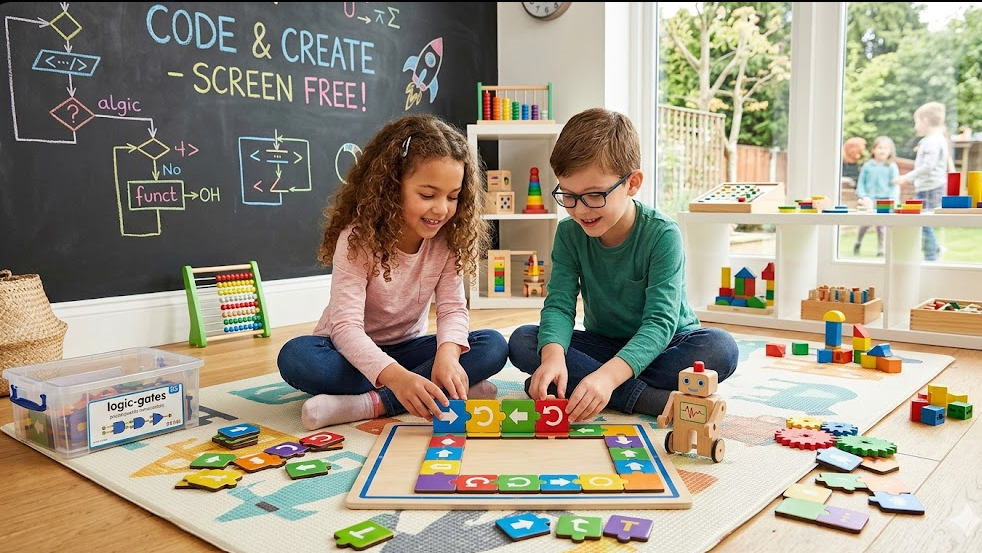
In today’s digitally saturated world, the sight of children hunched over tablets is nearly universal. While technology offers benefits, concerns about eye strain, reduced attention spans, and passive consumption have many parents and educators searching for alternatives. A powerful answer is emerging in the form of “Screen-Free Computational Play.” This movement brings the logic and problem-solving skills of computer programming into the physical world, all without a single screen.
This approach emphasizes “algorithmic thinking” through tangible, hands-on activities. It moves computer logic off the monitor and onto the play mat, using physical objects to represent commands and instructions. The goal is not necessarily to teach specific programming languages but to instill the underlying principles of computational logic and sequential thinking. In image_14.png, we see this in action: two children are physically programming a logic puzzle using large, tactile blocks and a wooden robot.
At the heart of computational thinking is the ability to break down complex problems into smaller, manageable steps. Screen-free play requires children to physically sequence commands. To move a robot from point A to point B, they must determine the exact sequence of actions: “forward, forward, turn right, forward.” This tangible process forces them to visualize and verify their instructions, a critical step in building strong logical reasoning. By manipulating blocks labeled “Start,” “Forward,” or “If/Then” functions, they deepen their understanding of sequential operations.
Traditional programming can be a solitary activity, but screen-free computational play is often designed for interaction. In the scene depicted in image_14.png, the two children are clearly collaborating on their puzzle, likely discussing the rules of the logic gate they are building. This emphasizes social skills, negotiation, and teamwork. They must communicate their logical plans, troubleshoot errors together (the “debugging” process), and celebrate shared solutions, leading to higher-order critical thinking and resilience.
By grounding computational concepts in a concrete, physical form, children develop a deep, intuitive understanding of abstract principles. These screen-free skills form a robust foundation that direct translates to mathematics, physics, and eventually, digital coding proficiency. They move past memorization toward a conceptual understanding that endures. The scene in image_14.png, set in a rich learning environment that also includes an abacus and logic puzzle pieces, exemplifies this synthesis of diverse, fundamental thinking skills.
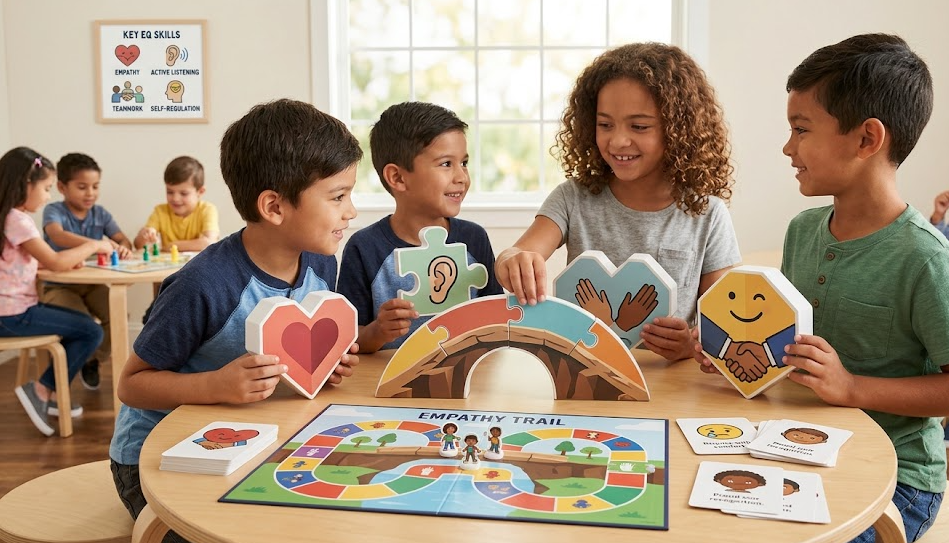
In an era where social dynamics are increasingly complex, the ability to understand and manage emotions is just as critical as academic knowledge. While traditional board games often focus on individual victory, Cooperative EQ Games flip the script. In these activities, players win or lose together, shifting the focus from competition to connection.
Traditional games often create a “winner” and a “loser,” which can lead to frustration or exclusion for younger children. Cooperative games, like the one seen in our latest classroom scene, require children to combine their strengths to solve a common challenge. By working together to navigate the “Empathy Trail,” children learn that collective success is more rewarding than individual gain. This collaborative environment reduces anxiety and allows kids to focus on the social interactions happening at the table.
In EQ games, players must communicate their thoughts and listen to their teammates to progress. If a player holds a piece representing “Listening” or “Self-Regulation,” they must explain how that skill helps the team overcome an obstacle. This practice turns abstract social concepts into tangible actions. As children discuss their moves, they naturally practice active listening—paying close attention to their peers’ ideas and feelings before making a decision.
A core component of EQ games is the identification of feelings. Using visual aids—such as cards featuring various facial expressions or symbols like a heart for empathy—children learn to name complex emotions. When a child picks a card that shows a “sad” face, the game might prompt the group to discuss how they could comfort that person. This validates the importance of all emotions and teaches children that empathy is an active choice they can make every day.
The goal of EQ games is to build a “bridge” between the play mat and real-life interactions. The wooden bridge puzzle seen in the classroom isn’t just a toy; it’s a metaphor for building relationships. When children learn to regulate their emotions during a game, they are better equipped to handle a disagreement on the playground or a difficult moment in the classroom. These games provide a safe space to practice the “soft skills” that lead to lifelong social and professional success.
| Skill | Game Action | Real-Life Benefit |
| Empathy | Helping a teammate move | Better friendships |
| Self-Regulation | Waiting for a group decision | Improved focus |
| Teamwork | Solving a shared puzzle | Collaborative leadership |
| Communication | Explaining a “Feeling Card” | Clearer expression of needs |
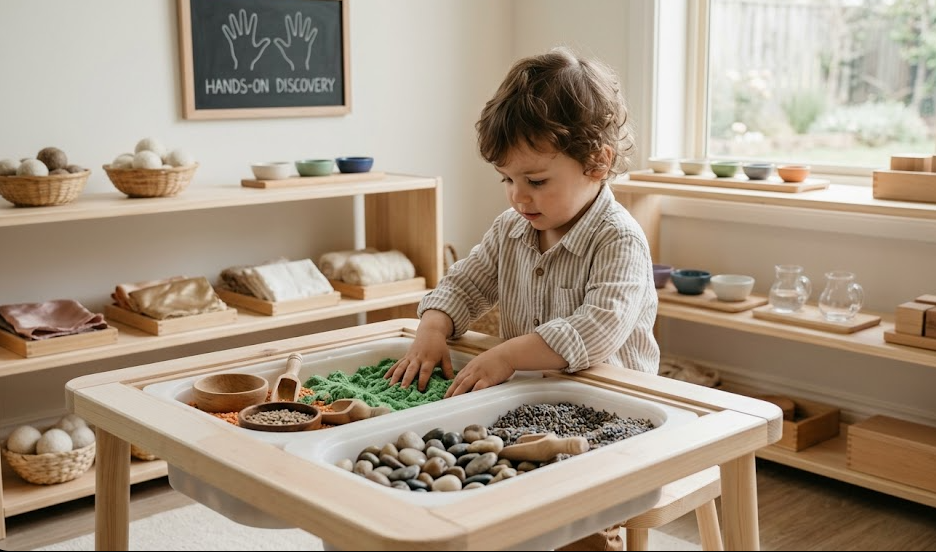
In the early years of a child’s life, the world is a vast, unfiltered tapestry of sensory input. Dr. Maria Montessori observed this and designed an educational philosophy that respects the child’s natural drive to explore and learn through their senses. Sensory-based Montessori exploration is a cornerstone of this approach, fostering not just physical dexterity, but cognitive clarity and emotional groundedness.
One key characteristic of Montessori sensory materials is the isolation of a specific quality. For example, rather than a puzzle that combines shapes, colors, and textures, a Montessori material might focus solely on grading shapes by size. This allows the child to refine their perception of dimensions without other sensory distractions. In image_16.png, we see this principle applied. The multi-compartment sensory bin presents distinct textures—vibrant kinetic sand, smooth river stones, and textured dried lentils—all contained and organized. This separation allows the child to focus intensely on the unique tactile feedback of each material, sharpening their discrimination skills.
Children in the modern world are often overstimulated, making sustained concentration difficult. Montessori sensory work, by contrast, is characterized by peaceful, deep absorption. In the provided image, the child with brown curls and a linen shirt is completely engrossed. One hand is in the green sand, the other resting near the smooth stones. This focus, often referred to as a “flow state,” is a direct result of engaging with tactile, purposeful materials. The quiet, organized background and natural daylight in image_16.png mirror the ideal Montessori classroom environment, reducing external distractions and supporting the child’s inner process of concentration.
While exploring textures, the child is also refining complex motor skills. When they run their fingers through sand, scoop lentils, or grasp smooth stones, they are exercising the small muscles in their hands and fingers. The wooden scoops and bowls visible in the child’s sensory bin require careful manipulation. This physical interaction builds fine motor dexterity and the foundational muscle memory needed for writing, drawing, and precise everyday tasks. The deliberate movements required for ‘HANDS-ON DISCOVERY,’ as the chalkboard indicates, turn tactile play into structured, skill-building physical education.
Sensory inputs do not remain isolated; they are the pathway to abstract understanding. By directly experiencing qualities like rough, smooth, heavy, light, or granular, the child builds a “sensory alphabet” of concepts. When they are later introduced to abstract language—like sorting by weight or describing textures—they have a real, tactile reference point. The various materials on the open, organized shelves behind the child in image_16.png (wool balls, textured swatches, grading bowls) represent a curriculum designed to take these sensory skills to higher, more abstract levels, connecting physical exploration directly to cognitive growth.
With our newsletter, you'll never miss an important update.