
In today’s digitally saturated world, the sight of children hunched over tablets is nearly universal. While technology offers benefits, concerns about eye strain, reduced attention spans, and passive consumption have many parents and educators searching for alternatives. A powerful answer is emerging in the form of “Screen-Free Computational Play.” This movement brings the logic and problem-solving skills of computer programming into the physical world, all without a single screen.
What is Screen-Free Computational Play?
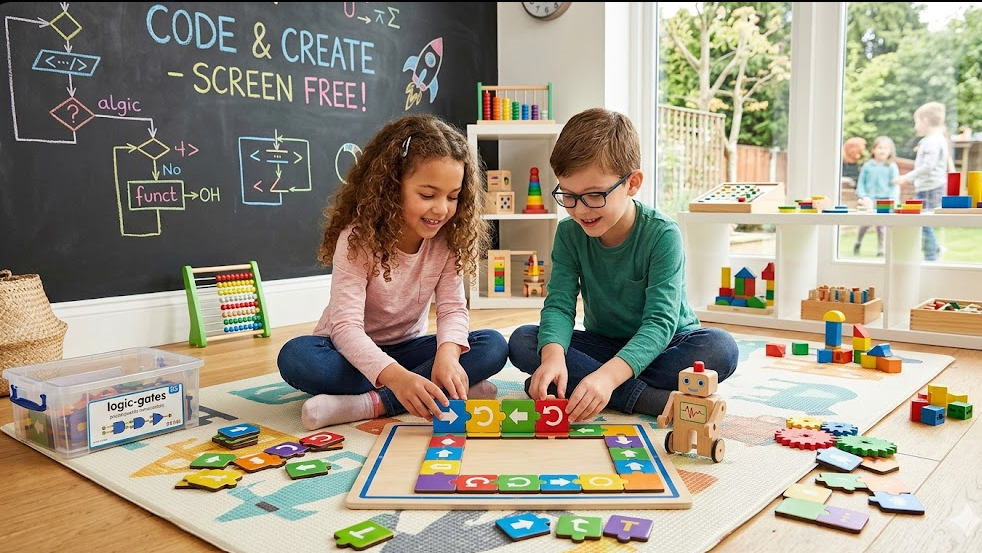
This approach emphasizes “algorithmic thinking” through tangible, hands-on activities. It moves computer logic off the monitor and onto the play mat, using physical objects to represent commands and instructions. The goal is not necessarily to teach specific programming languages but to instill the underlying principles of computational logic and sequential thinking. In image_14.png, we see this in action: two children are physically programming a logic puzzle using large, tactile blocks and a wooden robot.
Developing Logical Reasoning and Sequencing
At the heart of computational thinking is the ability to break down complex problems into smaller, manageable steps. Screen-free play requires children to physically sequence commands. To move a robot from point A to point B, they must determine the exact sequence of actions: “forward, forward, turn right, forward.” This tangible process forces them to visualize and verify their instructions, a critical step in building strong logical reasoning. By manipulating blocks labeled “Start,” “Forward,” or “If/Then” functions, they deepen their understanding of sequential operations.
Fostering Collaborative Problem Solving
Traditional programming can be a solitary activity, but screen-free computational play is often designed for interaction. In the scene depicted in image_14.png, the two children are clearly collaborating on their puzzle, likely discussing the rules of the logic gate they are building. This emphasizes social skills, negotiation, and teamwork. They must communicate their logical plans, troubleshoot errors together (the “debugging” process), and celebrate shared solutions, leading to higher-order critical thinking and resilience.
A Bridge to Abstract Concepts and Future Skills
By grounding computational concepts in a concrete, physical form, children develop a deep, intuitive understanding of abstract principles. These screen-free skills form a robust foundation that direct translates to mathematics, physics, and eventually, digital coding proficiency. They move past memorization toward a conceptual understanding that endures. The scene in image_14.png, set in a rich learning environment that also includes an abacus and logic puzzle pieces, exemplifies this synthesis of diverse, fundamental thinking skills.