
In the early years of a child’s life, the world is a vast, unfiltered tapestry of sensory input. Dr. Maria Montessori observed this and designed an educational philosophy that respects the child’s natural drive to explore and learn through their senses. Sensory-based Montessori exploration is a cornerstone of this approach, fostering not just physical dexterity, but cognitive clarity and emotional groundedness.
The Foundation: Isolated Sensory Experiences
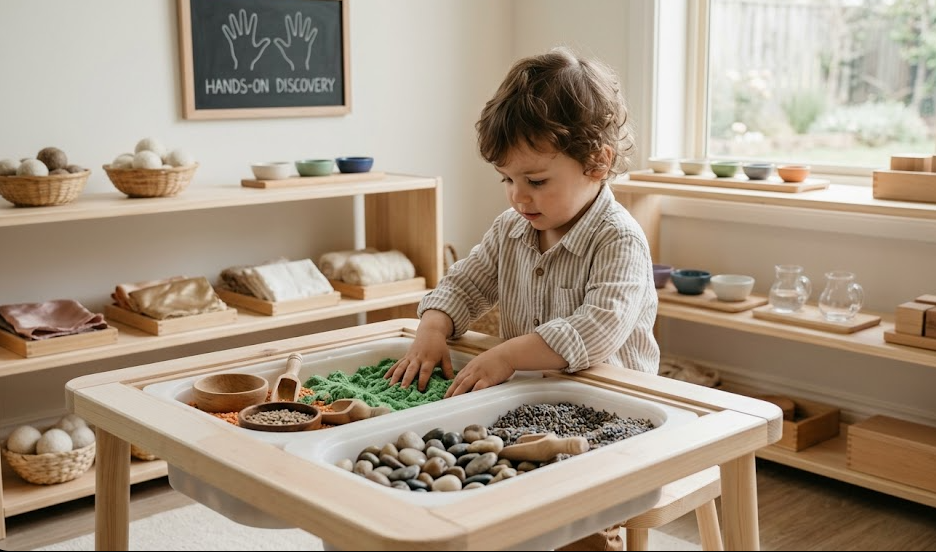
One key characteristic of Montessori sensory materials is the isolation of a specific quality. For example, rather than a puzzle that combines shapes, colors, and textures, a Montessori material might focus solely on grading shapes by size. This allows the child to refine their perception of dimensions without other sensory distractions. In image_16.png, we see this principle applied. The multi-compartment sensory bin presents distinct textures—vibrant kinetic sand, smooth river stones, and textured dried lentils—all contained and organized. This separation allows the child to focus intensely on the unique tactile feedback of each material, sharpening their discrimination skills.
Fostering Concentration and Inner Calm
Children in the modern world are often overstimulated, making sustained concentration difficult. Montessori sensory work, by contrast, is characterized by peaceful, deep absorption. In the provided image, the child with brown curls and a linen shirt is completely engrossed. One hand is in the green sand, the other resting near the smooth stones. This focus, often referred to as a “flow state,” is a direct result of engaging with tactile, purposeful materials. The quiet, organized background and natural daylight in image_16.png mirror the ideal Montessori classroom environment, reducing external distractions and supporting the child’s inner process of concentration.
Developing Dexterity and Muscle Memory
While exploring textures, the child is also refining complex motor skills. When they run their fingers through sand, scoop lentils, or grasp smooth stones, they are exercising the small muscles in their hands and fingers. The wooden scoops and bowls visible in the child’s sensory bin require careful manipulation. This physical interaction builds fine motor dexterity and the foundational muscle memory needed for writing, drawing, and precise everyday tasks. The deliberate movements required for ‘HANDS-ON DISCOVERY,’ as the chalkboard indicates, turn tactile play into structured, skill-building physical education.
Connecting Physical Input to Abstract Learning
Sensory inputs do not remain isolated; they are the pathway to abstract understanding. By directly experiencing qualities like rough, smooth, heavy, light, or granular, the child builds a “sensory alphabet” of concepts. When they are later introduced to abstract language—like sorting by weight or describing textures—they have a real, tactile reference point. The various materials on the open, organized shelves behind the child in image_16.png (wool balls, textured swatches, grading bowls) represent a curriculum designed to take these sensory skills to higher, more abstract levels, connecting physical exploration directly to cognitive growth.