
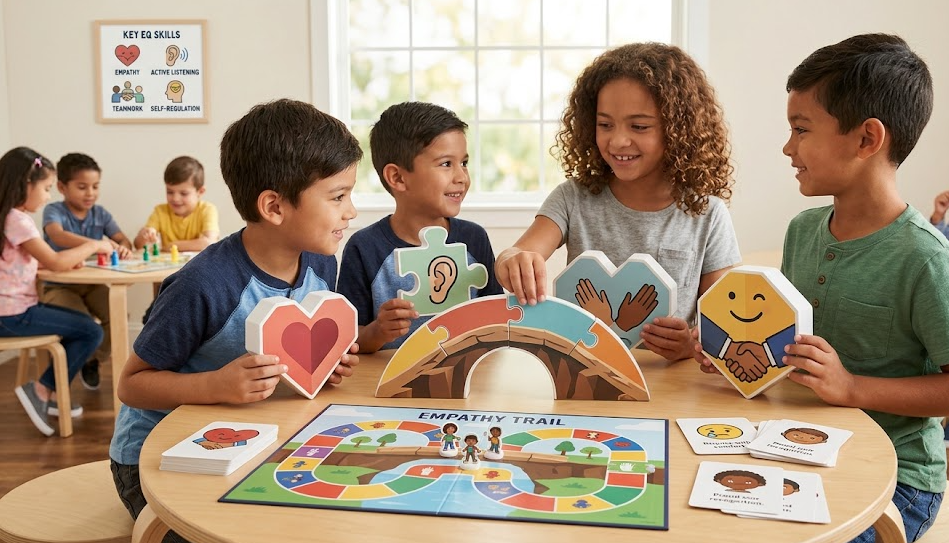
In an era where social dynamics are increasingly complex, the ability to understand and manage emotions is just as critical as academic knowledge. While traditional board games often focus on individual victory, Cooperative EQ Games flip the script. In these activities, players win or lose together, shifting the focus from competition to connection.
1. Moving from Competition to Connection
Traditional games often create a “winner” and a “loser,” which can lead to frustration or exclusion for younger children. Cooperative games, like the one seen in our latest classroom scene, require children to combine their strengths to solve a common challenge. By working together to navigate the “Empathy Trail,” children learn that collective success is more rewarding than individual gain. This collaborative environment reduces anxiety and allows kids to focus on the social interactions happening at the table.
2. Developing Active Listening and Communication
In EQ games, players must communicate their thoughts and listen to their teammates to progress. If a player holds a piece representing “Listening” or “Self-Regulation,” they must explain how that skill helps the team overcome an obstacle. This practice turns abstract social concepts into tangible actions. As children discuss their moves, they naturally practice active listening—paying close attention to their peers’ ideas and feelings before making a decision.
3. Identifying and Validating Emotions
A core component of EQ games is the identification of feelings. Using visual aids—such as cards featuring various facial expressions or symbols like a heart for empathy—children learn to name complex emotions. When a child picks a card that shows a “sad” face, the game might prompt the group to discuss how they could comfort that person. This validates the importance of all emotions and teaches children that empathy is an active choice they can make every day.
4. Real-World Application: The “Bridge” to Social Success
The goal of EQ games is to build a “bridge” between the play mat and real-life interactions. The wooden bridge puzzle seen in the classroom isn’t just a toy; it’s a metaphor for building relationships. When children learn to regulate their emotions during a game, they are better equipped to handle a disagreement on the playground or a difficult moment in the classroom. These games provide a safe space to practice the “soft skills” that lead to lifelong social and professional success.
Core EQ Skills Developed Through Play
| Skill | Game Action | Real-Life Benefit |
| Empathy | Helping a teammate move | Better friendships |
| Self-Regulation | Waiting for a group decision | Improved focus |
| Teamwork | Solving a shared puzzle | Collaborative leadership |
| Communication | Explaining a “Feeling Card” | Clearer expression of needs |